
When the River Speaks: Wildlife Insights at Rio Acre Ecological Station
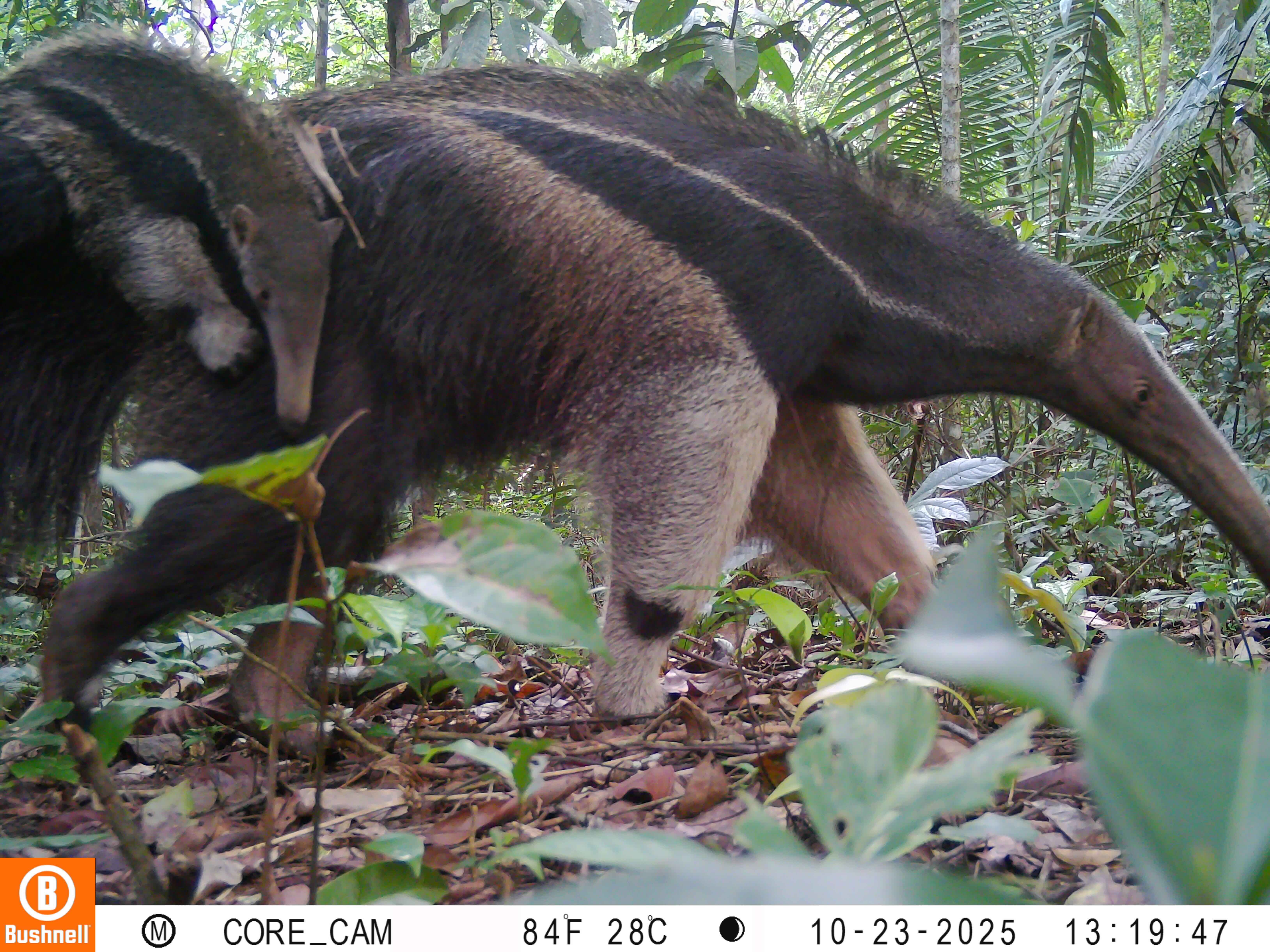
Deep in the western Brazilian Amazon, where the Acre River winds through flooded forests and bamboo stands, a team of researchers set out to answer three questions that focus on how this ecosystem works: Does water control where animals go? Where does the giant anteater truly belong? And can jaguars and pumas share the same landscape without driving each other out?
To find out, they deployed 52 camera traps across nearly 80,000 hectares of the Rio Acre Ecological Station, one of Brazil's strictly protected Amazonian reserves, managed by the Chico Mendes Institute for Biodiversity Conservation (ICMBio,) and let the cameras run for 229 days. The station, which is supported by the Amazon Sustainable Landscapes Program, sits along the border with Peru, in Acre state, and its strict protection status means no permanent residents, no tourism, just forest, river, and wildlife. Yet even here, illegal logging in surrounding areas and increasingly erratic rainfall from climate change are beginning to cast shadows over the landscape.
How Wildlife Insights Helped
When the cameras were retrieved, researchers faced a formidable task: over 105,000 images to work through. Managing that volume using traditional methods would have taken months. Wildlife Insights changed that by providing a platform to upload, organize, and collaboratively validate species identifications, and to generate species accumulation curves that showed how complete the survey was.
"Given how long the cameras were deployed, we generated a very high number of records. If we had done this using traditional methods it would have taken so much longer!" — Laiane Gomes de Oliveira, Environmental Analyst, ICMBio
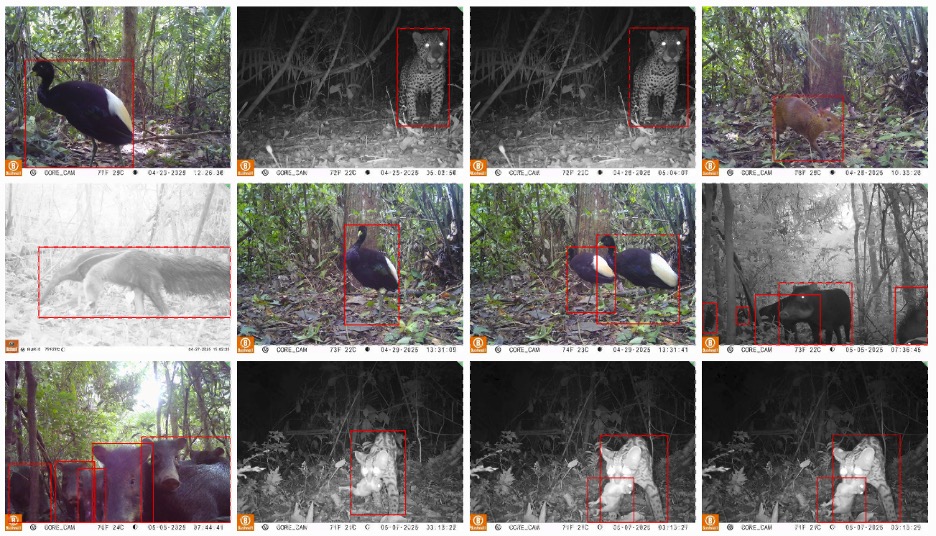
Compilation of species identified using Wildlife Insights at Rio Acre
What the Cameras Revealed
The survey confirmed 63 species, and the analysis estimates it captured roughly 90% of expected vertebrate diversity, a sign of a robust, well-sampled dataset. The broader picture was clear: Rio Acre remains an ecologically intact system, with large-bodied mammals like tapirs, peccaries, and deer detected alongside a diverse assemblage of ground-dwelling birds.
The most striking pattern? Water. Camera detections clustered consistently around the Acre River and adjacent floodplain forests. During dry periods, animals concentrate near remaining water sources; when the river floods, those same areas become movement corridors. The river doesn't just flow through this landscape, it organizes it, determining where wildlife feeds, moves, and shelters across the seasons.
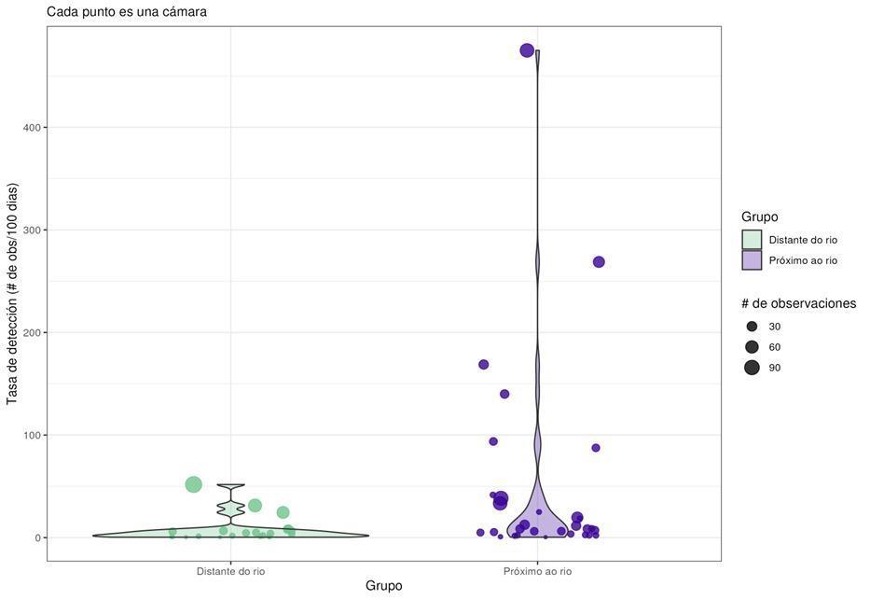
Species detection rates across forest (left) and floodplain habitat (right). Each point represents a camera trap location.
For the giant anteater, a species already sensitive to habitat quality, this floodplain preference was especially pronounced. Floodplain and gallery forests, with their moist soils and abundant decomposing wood, support far more ants and termites than upland areas. The anteaters follow their food. These habitats are not marginal zones; they are core habitat, essential for the species' survival in the region.
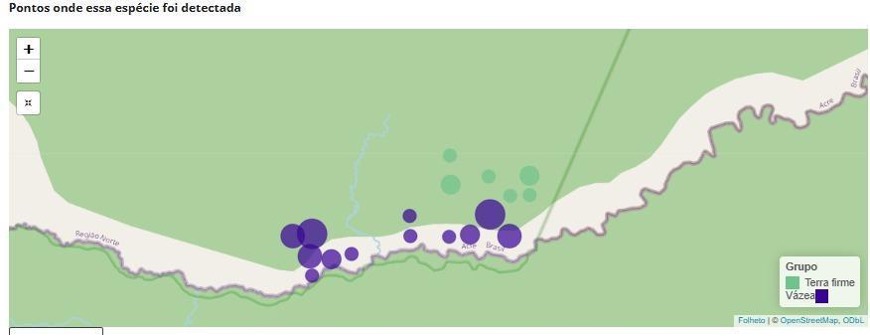
Giant anteater occupancy in forest (green points) vs. floodplain habitat (purple points). Circle size is proportional to detections.
The apex predator story was more nuanced. Jaguars and pumas overlapped considerably in both space and time, the activity chart produced in Wildlife Insights showing less partitioning than might be expected between two large, competing carnivores. The most likely explanation: a healthy prey base means competition pressure is low enough that both species can persist in the same landscape without direct conflict. For now, there is enough to go around.
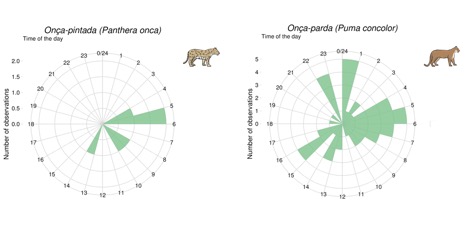
Comparison of daily activity patterns for puma (Puma concolor) and jaguar (Panthera onca)
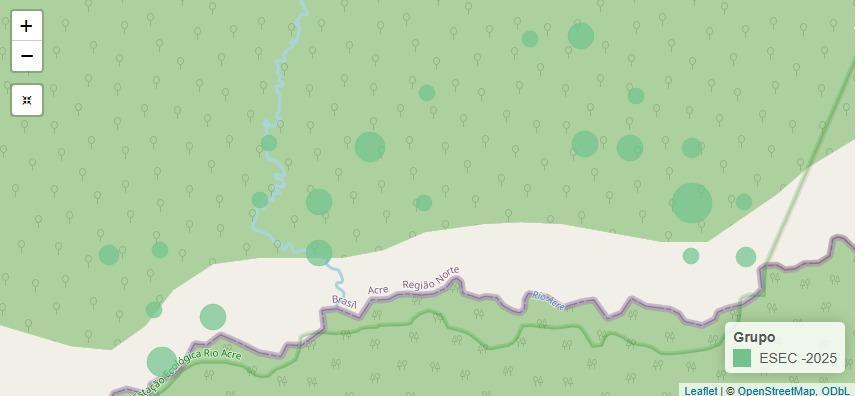
Puma (Puma concolor) detection locations across the station
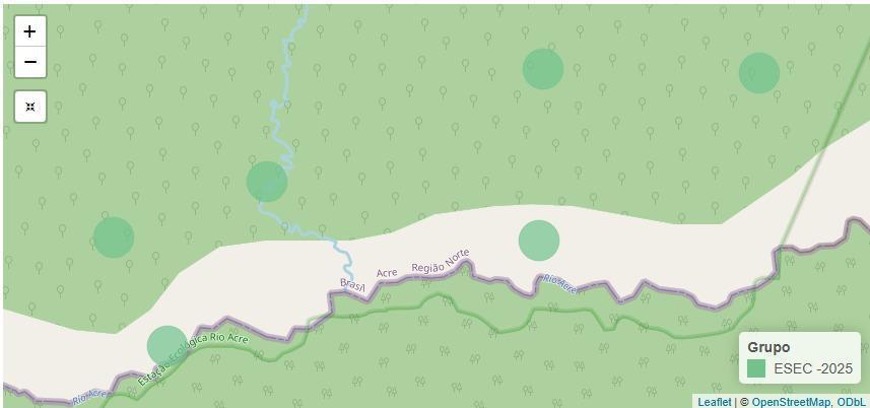
Jaguar (Panthera onca) detection locations. Circle size is proportional to number of detections.
Why It Matters
These findings paint a clear picture of Rio Acre as one of the Amazon's functioning, intact ecosystems, and they point directly to what needs protecting. Floodplain and gallery forests are not buffer zones; they are the ecological engine of the region, supporting the highest species richness and serving as corridors for movement and feeding. The health of the Acre River system directly determines the viability of multiple species.
The coexistence of jaguars and pumas is made possible by an intact prey base and large, connected habitat, but it is also a warning in disguise. Disrupt that connectivity, and the behavioral balance these predators rely on could collapse. The same goes for climate change: seasonal flooding patterns that currently concentrate and distribute wildlife may become less predictable, with cascading effects throughout the food web.
Rio Acre functions as a natural reference point; a window into how the Amazon organizes itself when left alone. That makes continued monitoring essential, not just for this station, but for understanding what is at stake across the broader region as human and climate pressures mount. The data generated here, processed and analyzed with Wildlife Insights, are helping build the evidence base for protecting one of the planet's most critical ecosystems.