
Long-Term Monitoring Baselines Provide Insights to Protect Against Emerging Threats in Suriname
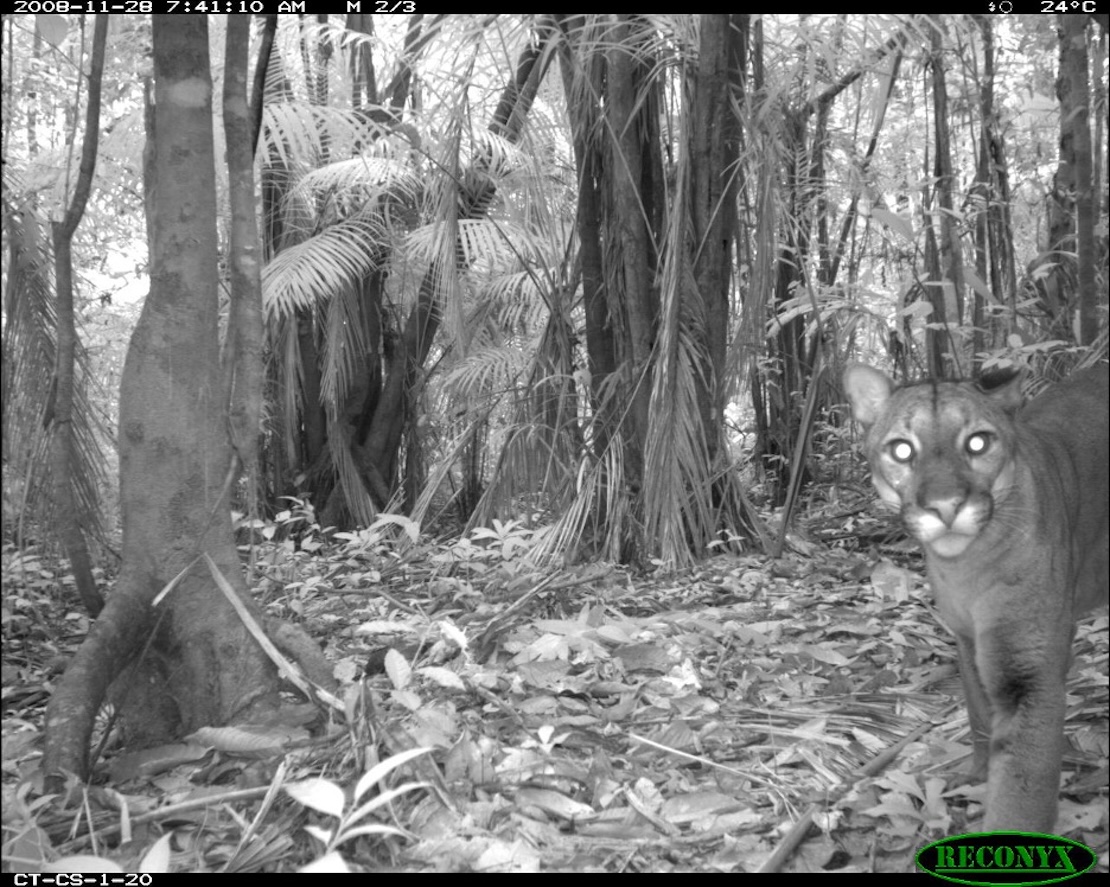
Deep in west-central Suriname lies one of the largest protected tropical forest areas on Earth, the Central Suriname Nature Reserve (CSNR). Spanning approximately 1.6 million hectares of largely undisturbed Guiana Shield rainforest, this UNESCO World Heritage Site encompasses a diverse range of ecosystems, including primary lowland and montane forests, granite inselbergs, riverine systems, and swamp forests. CSNR is managed under Suriname’s 1954 Nature Protection Law. Overall authority rests with the Head of the Suriname Forest Service (LBB) with LBB’s Nature Conservation Division (NCD) handling day-to-day management and enforcement.
This nature reserve represents a critical stronghold for South American biodiversity, and with support from the “Strengthening Management of Protected and Productive Landscapes in Surinamese Amazon” project through the Amazon Sustainable Landscapes 2 initiative, the management of this World Heritage Site was improved and local community engagement was strengthened.
However, even the most remote sanctuaries face ecological pressures. Today, the northern sector of the reserve, historically a center for ecotourism and research, is encountering severe external threats, including logging encroachment along its borders and limited on-the-ground management capacity. To protect this pristine wilderness against emerging threats, site managers urgently needed a clear, historical baseline to understand the ecosystem's health and track future changes.
How Wildlife Insights Helped
Between 2008 and 2017, camera trap surveys were systematically conducted under the standardized Tropical Ecology Assessment and Monitoring (TEAM) Network protocol. Deployed sequentially in a systematic grid across wildlife trails, 60 camera traps amassed a massive archive of 54,060 trap-days of data.
Wildlife Insights allowed CSNR site practitioners to seamlessly identify and analyze a decade of legacy data. With technical and facilitation support from WWF-Guianas, NCD analyzed the legacy dataset using Wildlife Insights tools to generate species accumulation curves and analyze jaguar activity patterns. This shifted data processing from a slow, laborious task into immediate, actionable conservation intelligence allowing the team to answer four key conservation questions to establish a robust biodiversity baseline, assess ecological dynamics, and support adaptive management in the face of emerging threats.
What the Cameras Revealed
The analysis of this robust historical record painted an incredible picture of a highly diverse, ecologically intact terrestrial community:
- Exceptional Species Richness: The cameras recorded a total of 60 distinct species, including 35 mammals and 25 ground-dwelling birds. The species accumulation curve approached stabilization, projecting a total richness of 62 species. This indicates that long-term monitoring successfully captured an impressive 97% of the expected species community, representing a wide range of functional groups from apex predators to herbivores and insectivores.
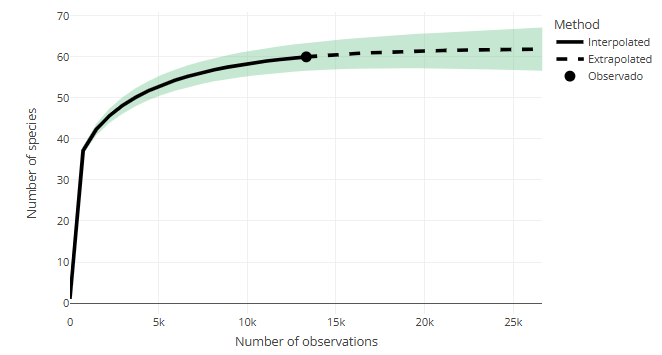
Species accumulation curve.
- Intact Trophic Dynamics: Small- to medium-sized herbivores and omnivores, such as agoutis, red acouchis, brocket deer, and pacas, were the most frequently captured, alongside larger herbivores like tapirs and white-lipped peccaries. Apex predators like the jaguar and puma were detected at naturally lower frequencies. The overall prey-to-predator detection ratio was a well-structured 20:1, signaling a healthy, functioning food web.
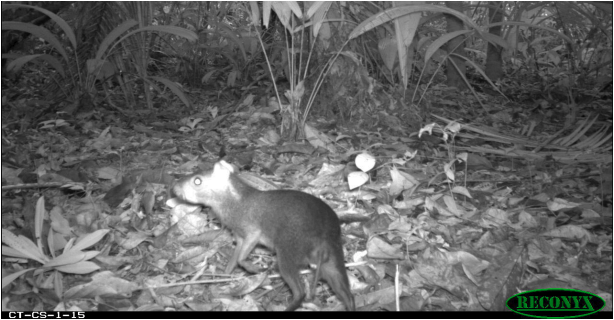
Red acouchi (Myoprocta acouchy), CSNR. Photo courtesy of Conservation International Suriname, a member of the TEAM network.
- Stable Apex Predator Populations: Over the nine-year span, the cameras captured 71 distinct jaguar detections. While detection rates naturally fluctuated year-to-year due to natural movement patterns and varying sampling effort, there was no consistent increasing or decreasing trend. The jaguar population remained remarkably stable, providing a critical pre-disturbance baseline.
- Flexible Predator Behavior: The dataset revealed that jaguars in the northern CSNR possess highly variable temporal activity patterns. While nocturnal movements were standard, significant midday activity was consistently recorded. No singular, predictable peak activity period was identified, showing that individual behaviors shift dynamically based on habitat structure, prey movement, and human presence near ecotourism hubs.
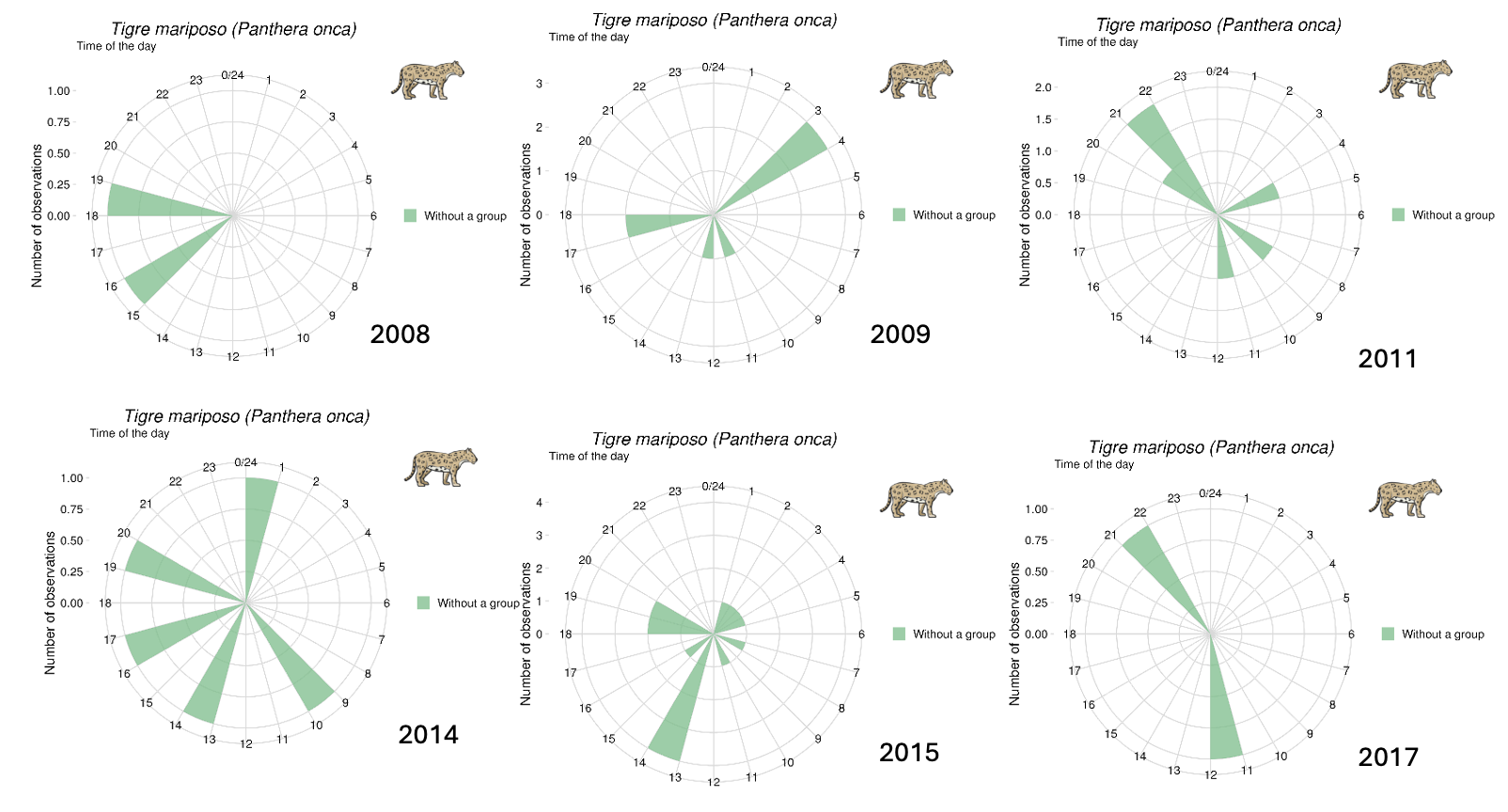
A sample of jaguar activity pattern charts throughout the study period.
Why It Matters
The high biodiversity and intact ecological processes underscore the global importance of maintaining strict protection across the reserve. The insights retrieved from this historical dataset provide a vital baseline for the future of conservation in Suriname, highlighting several important management priorities.
The stable jaguar population and strong prey base indicate that ecological conditions remained favorable during the monitoring period; however, the absence of post-2017 data limits the ability to assess recent impacts from logging and increased access. Resuming standardized monitoring is therefore critical.
The variability in jaguar activity patterns suggests that management actions such as patrols should not be restricted to specific times of day. Instead, flexible and continuous monitoring approaches are required.
More broadly, the results emphasize the need to strengthen on-the-ground management capacity, improve enforcement in high-risk areas, and integrate monitoring data into decision-making processes.